
4–8 Weeks Ahead: Corporate Bulk Orders for Singapore Events
For Singapore events, plan 4 to 8 weeks ahead and expect supplier minimum order quantities typically start in the mid-hundreds for mid-tier branded or custom corporate gifts. The next step is simple: prepare a written RFQ, confirm your supplier’s GST and tax invoice setup against IRAS.pdf?sfvrsn=8a66716d_110) requirements, and check PEPPOL readiness if you are invoicing a government or large-corporate buyer.
TL;DR:
- Simple branded merchandise may start at 50 to 100 units, catalogue sourcing at 150 to 300, and bespoke gift boxes at 300 or more.
- Off the shelf fruit boxes take 1 to 2 weeks; allow 3 to 4 for branded selections and 6 to 8 for custom boxes or imported fruit.
- Require itemized quotes for product, customization, packaging, and delivery; fruit orders also need separate chilled logistics, since perishability and multiple locations can raise costs.
- For taxable sales between GST registered businesses, tax invoices are due within 30 days of the earlier invoice or payment date.
- Government agency invoices require PEPPOL routing through an approved vendor record, while private corporate buyers should confirm whether their finance systems require this format.
Table of Contents
- Typical MOQ tiers and indicative Singapore price bands
- Line-item cost drivers: the exact factors that push cost up or down
- Lead times and a backwards timeline you can use to plan to an event date
- RFQ and procurement checklist: what to include in your brief and purchase order
- Budget planning: build a cost-per-recipient model and total landed cost
- GST, invoicing and e-invoicing rules that matter for Singapore procurement
- How to evaluate suppliers and questions to ask
- Tai Kang Healthy Fruits: how we deliver bulk corporate orders in Singapore
- Quality assurance and inspection protocols for bulk fruit orders
- Packaging and handling best practices to maintain fruit freshness during delivery
- Customer support and dispute resolution process for corporate bulk orders
- Author perspective: practical procurement tips for perishable corporate gifts
- Order corporate fruit gifts with us
- FAQ
- Sources
Typical MOQ tiers and indicative Singapore price bands
Suppliers in Singapore generally group corporate orders into three MOQ tiers, and knowing which tier your request falls into helps you judge whether a quote is reasonable before you even open the spreadsheet. Local corporate-gifting guides commonly classify vendors as low-MOQ fast printers, catalogue sourcers with mid-range MOQs, and premium bespoke makers with the highest minimums and the longest lead times.
Low-MOQ fast printers typically accept orders from 50 to 100 pieces for simple branded merchandise such as printed tote bags or stickered mugs. Catalogue sourcers, who pull from existing product ranges and add light branding, usually set minimums between 150 and 300 pieces. Premium bespoke makers, including custom gift box producers, often require 300 pieces or more because tooling, packaging design, and sourcing coordination do not scale down economically.
Price bands move with these tiers:
- Simple branded merchandise: generally the lowest per-unit cost, with pricing driven mostly by print method and material grade rather than volume.
- Premium gift boxes with custom inserts or branded sleeves: mid-to-high per-unit cost, since box construction and assembly labor add up regardless of order size.
- Perishable corporate fruit boxes: pricing depends heavily on fruit selection and the number of inclusions in each box, and perishability removes the option of overproducing to hit a price break.
A practical guide that focuses on MOQ, lead time, and supplier responsiveness as the three factors procurement teams check first can help you benchmark a quote even before pricing is finalized, since MOQ and lead time often move together in supplier pricing models.
To compare quotes fairly, ask every supplier to break the unit price into the same components: base product, decoration or customization, packaging, and delivery. A quote that bundles everything into one number is harder to benchmark and often hides a markup in one category. When one supplier’s per-unit price looks far lower than the others for the same spec, check whether they have quietly dropped a packaging element, reduced the fruit count per box, or shifted logistics cost onto a separate line you have not seen yet.

Line-item cost drivers: the exact factors that push cost up or down
Once you have a price band, the next step is understanding what actually moves the number up or down on a specific quote. For fruit-based corporate gifts, the cost structure differs from non-perishable merchandise in a few important ways.
- Material, complexity, and perishability. A box of seasonal fruit priced by weight and variety behaves differently from a printed pen: perishable stock has a shelf life, so suppliers price in wastage risk and cannot hold excess inventory to smooth out a rush order.
- Decoration and branding charges. Printed ribbons, branded sleeves, or custom tags usually carry a one-time setup or tooling fee, which is why very small orders often see a disproportionately high branding charge per unit.
- Packaging and presentation. Inner packaging (tissue, trays, cushioning for fruit) and gift-ready assembly (ribbon tying, card insertion) are labor costs that scale with order complexity more than with volume.
- Logistics and handling. Chilled transport for fruit, last-mile delivery across multiple office addresses, and contingency for returns or damaged items all add to the landed cost, and these are the costs most often underestimated in a first-draft budget.
- Payment and currency impacts. Imported fruit varieties priced in a foreign currency can shift between the quote date and the payment date, so locking in a quote validity period protects your budget from exchange rate movement.
Pro Tip: Ask suppliers to quote chilled logistics as a separate line item, since this is the cost most likely to balloon on last-minute or multi-site deliveries.
Lead times and a backwards timeline you can use to plan to an event date

Working backward from your event date is the most reliable way to avoid a last-minute scramble, and the right buffer depends on how complex the order is. Low-complexity orders (off-the-shelf fruit boxes, no custom branding) can often be confirmed and delivered within 1 to 2 weeks. Medium-complexity orders (branded sleeves, custom card inserts, mixed fruit selections) typically need 3 to 4 weeks to allow for sample approval and production. High-complexity orders (fully custom gift boxes, imported specialty fruit, multi-site delivery schedules) should be planned 6 to 8 weeks out.
A simple backwards plan, counting back from your event day:
- Event day: final delivery and setup confirmed; keep a same-day contact on file in case of a delivery issue.
- 3 to 5 days before: delivery window confirmed with the supplier, recipient list and addresses locked.
- 1 to 2 weeks before: production complete, quality check done, tax invoice issued and matched to your purchase order.
- 3 to 4 weeks before: sample approved and signed off, full production begins.
- 5 to 6 weeks before: RFQ sent, quotes compared, supplier selected, deposit or payment terms agreed.
- 6 to 8 weeks before: budget approved internally, product specs and quantities finalized.
Fruit gift boxes compress this timeline compared to non-perishable items, since fruit cannot be produced and stored weeks ahead. A non-perishable item might be produced three weeks early and warehoused, while a fruit order is typically assembled in the final days before delivery to protect freshness. Build in a buffer for sample approval specifically: a signed-off sample tied to a specific date gives both sides a clear reference point and avoids disputes over scope later in production.
RFQ and procurement checklist: what to include in your brief and purchase order
A well-built RFQ saves time on both sides and makes quotes genuinely comparable. Structure your brief around these fields:
- Item specifications. Exact product names, quantities, fruit varieties or substitutions allowed, box dimensions, and any dietary notes.
- Artwork and branding files. Logo files in vector format, brand color codes, and placement instructions for any printed element.
- Sample instructions. Request a physical sample before full production, with a clear sign-off deadline tied to your backwards timeline.
- Packaging and delivery method. Specify inner packaging requirements, outer carton needs for multi-site delivery, and delivery windows per address.
- GST and invoicing fields. Confirm the supplier’s GST registration status, request a proper tax invoice, and specify whether you need an e-invoice format.
- Payment terms and banking details. State your payment terms clearly, request the supplier’s PO number reference on all invoices, and confirm banking details in writing before the first payment.
- Cold chain requirements for perishable orders. For chilled or fresh fruit orders, request proof of temperature-controlled storage and transport, and specify acceptable temperature ranges on arrival.
Asking for all of this up front, rather than chasing it after a quote arrives, is what separates a procurement-ready brief from an informal email inquiry.
Budget planning: build a cost-per-recipient model and total landed cost
The most useful number for an internal budget paper is cost per recipient, not just unit price. Build it as: base unit cost, plus packaging, plus chilled handling if applicable, plus delivery allocated per recipient, plus GST, plus a contingency line for damage or substitutions.
Before GST, that is $23 per unit plus $1.15 contingency, for $24.15 per recipient. At 50 recipients that is $1,207.50 before GST; at 300 recipients, assuming a volume discount brings the base cost down slightly, the per-unit total might land closer to $21 to $22, giving a landed cost in the $6,300 to $6,600 range before GST. At 1,000 units, further volume pricing and shared delivery logistics typically bring per-unit cost down again, though chilled logistics at that scale may require splitting delivery across multiple days.
- Compare mixed-quantity purchase orders by normalizing everything to cost per recipient, not total PO value, since bundled discounts can distort a straight total comparison.
- Consider splitting a large order across two suppliers when one supplier’s MOQ or lead time cannot meet your date, even if it means losing some volume discount.
- Favor the more reliable supplier over the cheapest one when the order is tied to a fixed event date, since a missed delivery costs more in reputational terms than a small per-unit saving.
GST, invoicing and e-invoicing rules that matter for Singapore procurement
GST in Singapore is a broad-based consumption tax, and suppliers effectively act as collection agents on most goods and services sold to your business, which makes the tax invoice the document your finance team needs to reclaim input tax.
The time of supply for GST purposes is generally the earlier of the invoice date or the payment date, and suppliers must issue a tax invoice within 30 days of the time of supply for a taxable supply to another GST-registered business. This matters for procurement because if your invoice date and your payment date fall in different accounting periods, the earlier one usually governs when GST is accounted for.
If you are procuring for a government agency or a large corporate buyer with standardized vendor systems, confirm e-invoicing capability before awarding the order. Vendors submitting e-invoices to Singapore government agencies must route them through the PEPPOL network with an approved vendor record, and a non-compliant e-invoice can be rejected outright, which delays payment processing. Before awarding a bulk order, confirm the supplier’s GST registration number, request a sample tax invoice format, and ask directly whether they can issue PEPPOL-compliant e-invoices if your organization requires them.
How to evaluate suppliers and questions to ask
Price alone does not tell you whether a supplier will deliver reliably on an event date. Written briefs paired with clear supplier service signals, such as a dedicated account contact and a curated proposal rather than a generic price list, tend to correlate with more reliable vendor relationships in Singapore procurement practice.
- Ask whether the supplier has chilled storage capacity and what their fulfillment service level looks like under volume pressure, including considerations from a restaurant equipment cost in Singapore: a startup budget guide for energy-efficient kitchen appliances and storage solutions.
- Ask for a named account contact and how order tracking or status updates are communicated during production.
- Request references from a past corporate order of similar size and ask specifically about on-time delivery performance.
- Treat a missing tax invoice, vague delivery timelines, or an unclear returns policy as red flags worth walking away from.
Pro Tip: A supplier that offers a dedicated account contact and proactive order tracking is often a better operational fit for a fixed-date corporate order than the lowest bidder on price alone.
Tai Kang Healthy Fruits: how we deliver bulk corporate orders in Singapore
We run Corporate Fruit Delivery built around the same checklist procurement teams already use: hand-inspected fruit, temperature-controlled storage from receiving through to dispatch, and home or office delivery across Singapore. Our corporate catalog includes Corporate Gift Box options alongside a Bi-weekly fruits delivery (2 months subscription plan) for teams that want recurring wellness gifting instead of a one-off order. We have a rewards program that supports repeat corporate accounts that order regularly throughout the year. For specs and order examples, our corporate fruit packs page is a useful reference point when you are building your own RFQ.
Quality assurance and inspection protocols for bulk fruit orders
Fruit is perishable, so quality assurance has to happen at every handoff rather than once at the end of production. A sound inspection protocol checks ripeness and firmness at intake, verifies there is no bruising or spoilage before packing, and confirms cold storage temperature is maintained from receiving through to the moment a box is sealed for delivery.
For a bulk corporate order, ask your supplier what their intake inspection actually covers: do they check every batch, or only a sample? Who signs off on a batch before it moves to packing? A supplier that can answer these questions specifically, rather than with a general assurance of quality, is more likely to catch a problem before it reaches your recipients.
Build your own acceptance criteria into the RFQ rather than assuming the supplier’s standard is the same as yours. Specify the fruit grade you expect, note any variety substitutions you will or will not accept, and request that a sample box be inspected and approved before full production begins. This is especially important for mixed boxes with several fruit types, since one underripe or overripe component can affect the whole presentation. Our own process at Tai Kang Healthy Fruits follows hand inspection before storage and before dispatch, which is the standard we apply to every order regardless of size.
Packaging and handling best practices to maintain fruit freshness during delivery
Packaging for a fruit gift has two jobs at once: protect the fruit physically and keep it at the right temperature until it reaches the recipient. Inner packaging such as fitted trays or cushioned dividers prevents bruising from fruit shifting during transport, which matters more for softer fruit like berries or pears than for firmer items.
Temperature control is the single highest-risk factor for a perishable order. Chilled logistics and verified cold-chain handling should be treated as a non-negotiable line item in your RFQ, not an assumed default, since a break in the cold chain during last-mile delivery can spoil an otherwise well-packed box before it arrives.
For multi-site corporate deliveries, ask your supplier how they sequence routes to minimize time outside temperature-controlled conditions, and whether delivery vehicles are refrigerated or use insulated packaging with ice packs for shorter routes. Outer packaging should also be sturdy enough to survive stacking during a multi-stop delivery run without crushing the contents. If your order includes a mix of fruit gift boxes and other items like snacks or drinks, pack perishables separately from shelf-stable items so handling requirements do not conflict.
Customer support and dispute resolution process for corporate bulk orders
A bulk corporate order should come with a clear point of contact before, during, and after delivery, not just a general inquiry email. Before placing the order, confirm who to contact if a delivery window needs to change or if a recipient address is wrong. During fulfillment, ask whether you will receive confirmation once the order is dispatched and once it is delivered.
If something goes wrong, such as a damaged box or a missed delivery slot, the resolution process should be specific: does the supplier offer a reship, a credit, or a refund, and what is the timeframe for raising an issue? Get this in writing before you place the order, since verbal assurances are hard to enforce after the fact. A supplier with a documented returns and dispute process, rather than a case-by-case approach, gives procurement teams more confidence when ordering at volume for a fixed event date.
Author perspective: practical procurement tips for perishable corporate gifts
The single most effective QA check I recommend for perishable corporate gifts is a physical sample inspection on the actual delivery day cadence, not just at order placement, since freshness at 9 AM looks different from freshness after a full day in transit. When an order is tied to a fixed event date, I lean toward the more reliable supplier over the cheaper one every time: a missed delivery costs more than a small per-unit saving ever will.
— Tai Kang
Order corporate fruit gifts with us
We handle the sourcing, inspection, and chilled delivery so your team does not have to coordinate multiple vendors for a wellness gift or event hamper. Whether you need a one-time order or a recurring arrangement, our catalog and corporate page are built for exactly the kind of RFQ process described above.
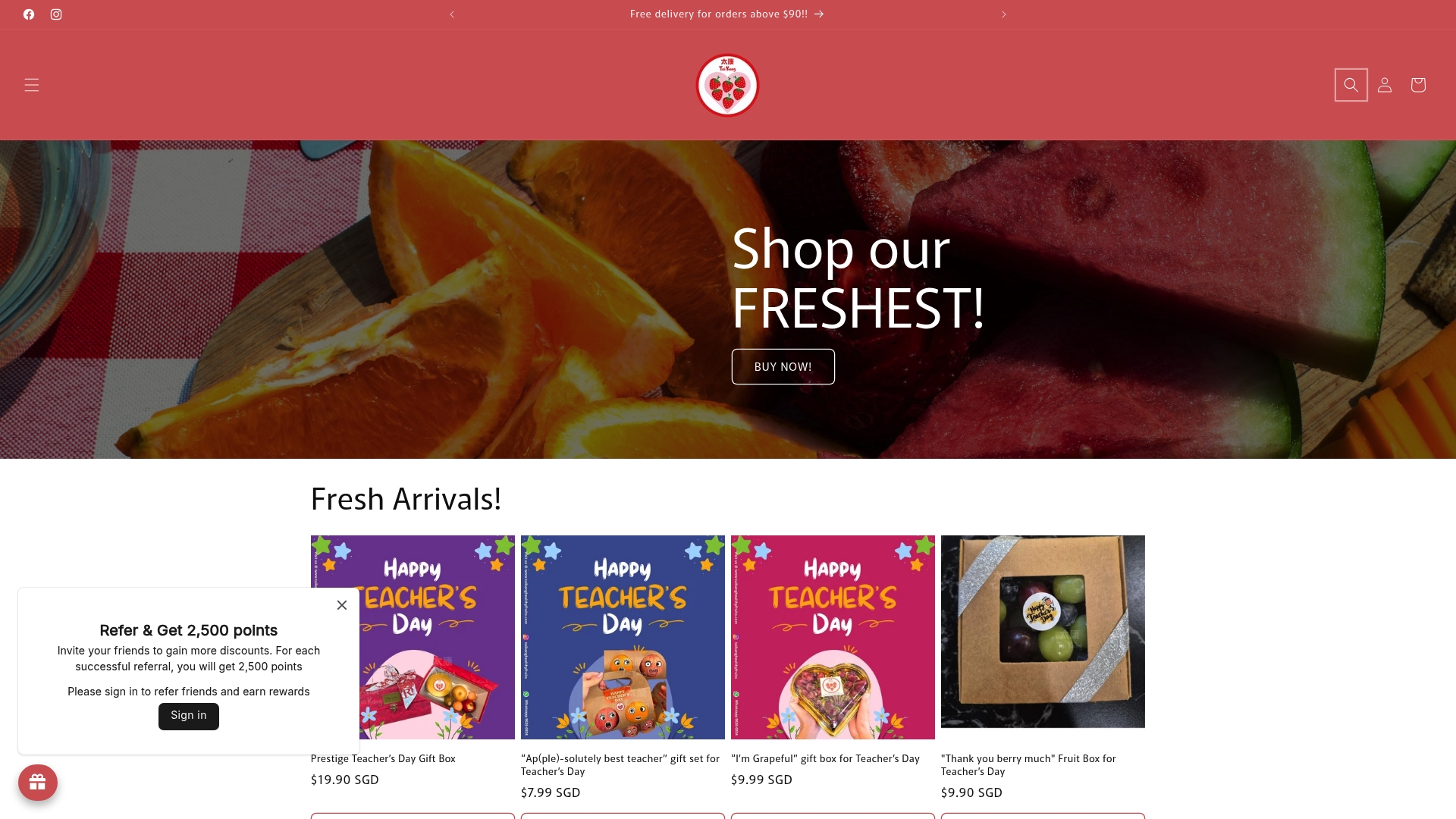
- For curated gift boxes, our Abundance Harvest Premium Gift Box and Omakase Gift Box suit wellness gifting and client appreciation.
- For themed or seasonal sends, the “Nourish and Flourish” Gift Box and “I cherry-ish you” Fruit box work well for team milestones.
- For recurring employee wellness programs, our bi-weekly fruits delivery subscription replaces one-off ordering with a set cadence.
- For single premium items at scale, options like Ecuador Sweet Passionfruit, Premium Candy Pear L (3pcs), and Fresh Pomegranate XXL (2pc) can be ordered in bulk for events.
Get in touch through our corporate fruit gift box collection to request a quote for your next event or wellness program.
FAQ
What is a typical MOQ for corporate fruit gift boxes in Singapore?
Minimum order quantities for custom or branded mid-tier corporate gifts generally start around 300 units, while simpler off-the-shelf fruit boxes can often be ordered in smaller quantities. The exact minimum depends on how much customization, packaging, and branding the order requires.
How far in advance should we order for a corporate event?
Plan 4 to 8 weeks ahead depending on complexity: low-complexity orders can be confirmed within 1 to 2 weeks, while fully custom gift boxes or imported fruit varieties need 6 to 8 weeks to allow for sampling and production. Building a backwards timeline from your event date is the most reliable way to avoid delays.
What should a tax invoice for a bulk fruit order include?
A compliant tax invoice must be issued within 30 days of the time of supply for a taxable supply between GST-registered businesses, and it is the document your finance team needs to reclaim input tax. Confirm your supplier’s GST registration status and invoicing format before placing a large order.
Do we need PEPPOL e-invoicing for a corporate fruit order?
PEPPOL e-invoicing is generally required when submitting invoices to Singapore government agencies, which requires an approved vendor record and CorpPass access. If you are a private corporate buyer, check your own finance system’s requirements, since some large corporates have adopted similar standardized invoicing expectations.
Can we get a corporate quote directly for fruit gift boxes?
Yes, we provide corporate fruit delivery and gift box options that can be quoted directly through our corporate collection page. Pricing depends on the product mix, quantity, and delivery locations you specify in your request.
Sources
- IMDA: E-invoice submission to Singapore Government Agencies via the PEPPOL Network
- SMU Academy: Strategic sourcing — supplier relationship management