
1–3 Sentence Corporate Gift Messages for Busy Teams With Tai Kang
Use short, one to three sentence messages built on greeting, specific appreciation, and warm closing. That formula beats generic lines like “thank you for your business” every time. Below you’ll find copy-ready templates grouped by recipient and occasion, plus quick rules on tone, personalization, timing, and which channel actually gets read.
TL;DR:
- Personalization linking to a recent project or milestone significantly increases the perceived sincerity of the gift message.
- Sending handwritten notes, especially for VIPs or high-value clients, yields higher engagement than digital or printed alternatives.
- Messages should be short, ideally one to three sentences, with a specific reference and a warm, forward-looking closing to maximize impact.
- Timing and channel choice influence whether the message is read and appreciated, with immediate delivery for impactful moments and handwritten notes for key relationships.
- The most memorable gift messages mention a real detail about the recipient’s work or an inside moment, not generic thanks, to foster loyalty and genuine appreciation.
Table of Contents
- Corporate Gift Message Ideas for Clients, Colleagues, and Employees
- How to Write a Gift Message: Greeting, Reference, Closing
- Personalizing a Business Gift Message So It Doesn’t Sound Generic
- When and How to Send: Handwritten, Email, SMS, or Card Insert
- Matching Fruit Gift Messages to the Occasion
- Ready-Made Corporate Fruit Gifts to Pair With These Messages
- What Actually Gets a Reaction
- Sources
- FAQ
Corporate Gift Message Ideas for Clients, Colleagues, and Employees
The fastest way to write a professional gift note is to steal a structure and swap in one true detail. Here are ready-to-use lines organized by who’s receiving the gift.
For clients:
- New client welcome: “Welcome aboard! We’re excited to start this partnership and appreciate you choosing us.”
- After a major deliverable: “Congratulations on the launch. Thank you for trusting us with a project this important.”
- Long-term client, short version: “Five years and counting. Grateful for the partnership.”
- Long-term client, longer version: “It’s been a pleasure working alongside your team since 2021. Thank you for your continued trust, and here’s to another great year ahead.”
- Holiday season: “Wishing you a restful season and a strong start to the new year. Thank you for a great year of collaboration.”
- Contract renewal: “Thrilled to continue working together. Thank you for renewing your trust in us.”
For colleagues and peers:
- Thanks for help: “You saved this project. Truly appreciate you jumping in when it mattered.”
- Promotion: “Well-deserved. Excited to see what you’ll do next in this role.”
- Farewell: “It won’t be the same without you down the hall. Wishing you the best in the next chapter.”
- Cross-team support: “Thanks for making that deadline possible. Your team came through in a big way.”
For employees:
- Recognition: “Your work this quarter didn’t go unnoticed. Thank you for the extra effort.”
- Work anniversary: “Three years of great work. Here’s a small thank-you for all you bring to the team.”
- Bonus or spot award: “You earned this. Keep up the momentum.”
- New parent or personal milestone: “Congratulations on the new arrival! Take this time to rest and enjoy.”
For partners and vendors:
- Post-project appreciation: “Thank you for the smooth delivery and the flexibility along the way.”
- Milestone anniversary: “Grateful for a reliable partnership. Here’s to more years of working together.”
Every line above follows the same skeleton: name the occasion, reference something specific, close warmly. The practical gift-message checklist that professional gifting guides recommend comes down to exactly this: pick the recipient category, match tone to occasion, add one real detail, keep it short.
How to Write a Gift Message: Greeting, Reference, Closing
Every effective corporate gift note follows the same three-part shape, and once you see it, you can build a message for almost any situation in under a minute.
- Greeting. “Dear [Name]” reads formal and fits executives, first-time clients, or condolence notes. “Hi [Name]” or “Hello [Name]” works for colleagues, repeat clients, and anyone you’d address by first name in an email.
- Specific reference. Name the project, the milestone, or the interaction. “Thank you for your business” says nothing. “Thank you for pushing that release through before the holiday” says everything.
- Warm closing. End on a forward-looking note: “Looking forward to more,” “Wishing you well,” or simply “With gratitude.”
Keep the whole note to one to three sentences. Longer messages read as a form letter someone forgot to trim. This matches the gift-message crafting advice that consistently favors messages tailored to the specific gift and occasion over generic filler.
A few tone rules worth following every time: skip humor around sympathy or layoff-related gifts, avoid anything that sounds like a sales pitch (“check out our new offering” has no place on a thank-you card), and sign with your title when writing to a client above your usual contact, or just your first name for peers and direct reports.
Pro Tip: Read your draft out loud before you send it. If it sounds like something a robot would write, cut it in half and add one real detail instead.
Personalizing a Business Gift Message So It Doesn’t Sound Generic
A message that references something real about the recipient carries far more weight than a generic thank-you. Six fast prompts can turn any template into something that feels written for one person:
- What project or deliverable just wrapped up?
- What specific result did they achieve (a launch, a renewal, a closed deal)?
- Did you share a recent meeting, call, or event worth mentioning?
- Is there a personal milestone (anniversary, promotion, new role) to acknowledge?
- What’s one thing this person specifically does well?
- Is there an appropriate inside detail (a shared joke, a running theme) that fits a professional tone?
A message that names the actual project or shared moment lifts the perceived value of the gift itself. “Thank you for trusting us with the Q3 rollout” does more work than “thank you for your business” ever will.
Compare these two:
Generic: “Thank you for being a valued client this year.”
Personalized: “Thank you for trusting us with the platform migration. It was a big lift, and your team made it easier.”
For large mailings, merge tags or tokens (client name, project name, renewal date) keep things efficient without losing the personal touch. Reserve handwriting for your highest-value accounts. A handwritten card takes longer, but the research on loyalty-building thank-you notes shows the extra effort reads as sincerity in a way a printed insert never quite does.

When and How to Send: Handwritten, Email, SMS, or Card Insert
Timing matters as much as wording. Send thank-you notes immediately for one-off deliverables, right after delivery for gift boxes, and slightly delayed if you’re also hoping for a review or testimonial, since asking too fast can feel transactional.
Channel choice depends on stakes and speed:
- Handwritten note: best for VIP clients, executive gifts, or anything meant to feel irreplaceable. Slower, but it’s the strongest differentiator you have.
- Email: fine for most business relationships, easy to personalize at scale, works well paired with a digital gift card.
- SMS: appropriate for quick, informal thanks between close colleagues or fast-moving vendor relationships, not for first-time clients.
- Card insert: the default for physical gift boxes. Keep it short since space is limited, and make sure it’s readable at a glance.
Timing and channel together shape whether a message gets read at all. CartBoss’s research on client thank-you notes found that the right channel and timing combination directly affects open rates and follow-through, which matters just as much for a gift note as it does for a receipt email.
Matching Fruit Gift Messages to the Occasion
Fruit and food gifts invite a different kind of language than a mug or a tote bag. Words like “fresh,” “thriving,” and “grown with care” fit the product in a way generic corporate phrasing doesn’t, and pairing a growth metaphor with a fruit gift creates a small but memorable moment when the box gets opened.
Here are six templates matched to specific gift lines:
- “Sending Good Vibes” Gift Pack, client thank-you: “Sending good vibes and fresh fruit your way. Thank you for a great quarter.”
- Same pack, employee recognition: “A small thanks for a big effort. Enjoy this while it’s fresh.”
- Omakase Gift Box, VIP client: “A curated selection for a valued partner. Thank you for trusting us with the details that matter.”
- Same box, milestone congratulations: “Congratulations on the milestone. This one’s handpicked to match the occasion.”
- Berries Bliss Medley Gift box, wellness-focused client: “A little seasonal sweetness to go with a great year of work together.”
- Same box, employee wellness note: “Enjoy while fresh. Thank you for the energy you bring to this team.”
Perishable gifts benefit from a note about the delivery window: a short line like “best enjoyed within a few days” helps the recipient plan and ties the freshness directly back to your name. The supplier pairs every order with temperature-controlled handling, ensuring the fruit’s freshness.
Ready-Made Corporate Fruit Gifts to Pair With These Messages
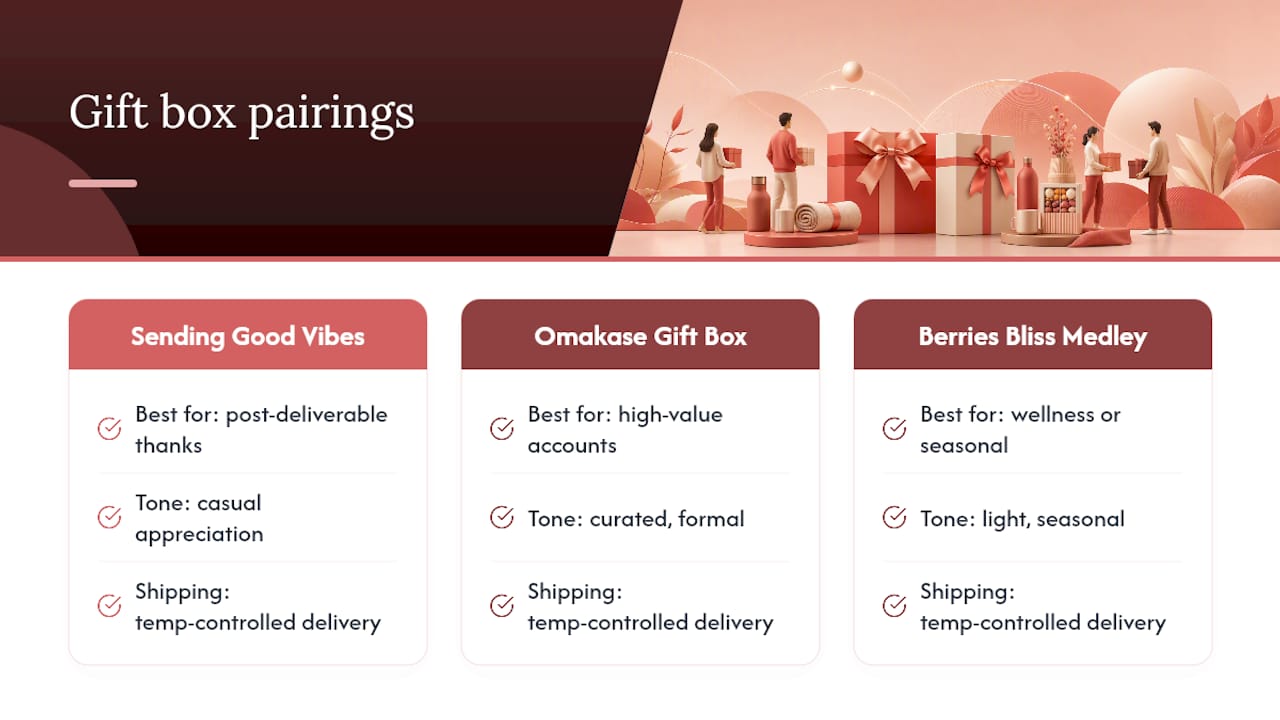
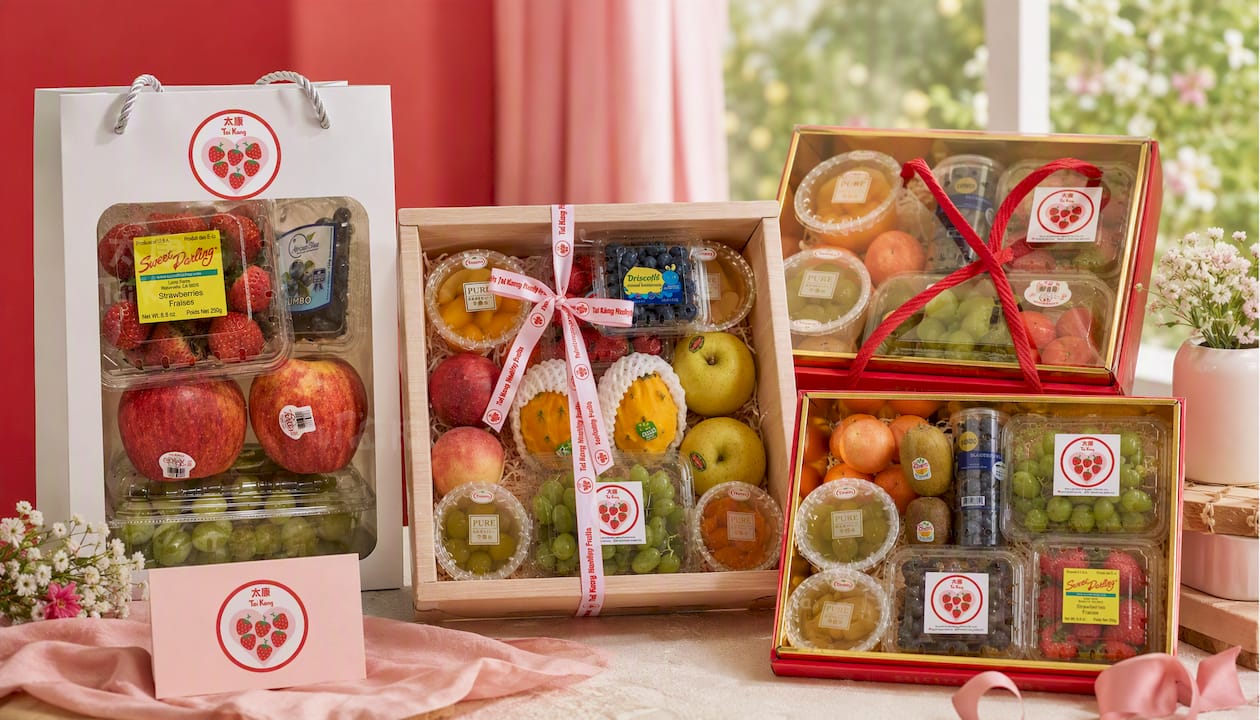
For a client you’re thanking after a big deliverable, the “Sending Good Vibes” Gift Pack covers general appreciation without overthinking it. For your highest-value accounts or a milestone that deserves more polish, the Omakase Gift Box brings a curated feel that matches a more formal note. If the recipient leans toward wellness or you want something lighter and seasonal, the Berries Bliss Medley Gift box fits that tone well.
Every gift ships with careful inspection and temperature-controlled delivery, so the fruit inside matches the care you put into the note, making it one of the corporate swag ideas employees actually keep. Browse the full corporate fruit gift box collection to find the right pairing, or head straight to checkout once you’ve picked a box and a message from above.
What Actually Gets a Reaction
The gift notes that get forwarded, screenshotted, or mentioned in a follow-up call are almost never the cleverest ones. They’re the ones that name something real: a launch date, a name, a specific week that was hard and got done anyway. Generic warmth reads as generic, no matter how nice the fruit inside the box is. The clients who’ve reordered the most from Taikanghealthyfruits over time tend to be the ones who received a note tied to something specific about their order, not a form line pasted onto a card insert. That’s not a coincidence. It’s the difference between a gift that says “we send these to everyone” and one that says “we noticed.”
— Tai Kang
Sources
- Crafting Effective Corporate Gift Messages – Sock Club Blog
- 8 Client Thank You Note Templates to Boost Revenue - CartBoss
- Thank you messages that build loyalty | FieldPie
- How to write a great gift message | Corporate Gift
FAQ
What’s a good short gift message?
Keep it to one sentence with a specific reference: “Thank you for trusting us with the launch. Enjoy!” works better than a generic thank-you because it names something real.
What is a good corporate greeting message?
Match formality to the relationship: “Dear [Name]” for first-time clients or executives, “Hi [Name]” for colleagues and repeat clients, followed by one specific detail and a warm close.
What is a short message I can write to a colleague for a gift?
Something like “You saved this project. Truly appreciate you jumping in when it mattered” works because it’s specific, brief, and skips generic phrasing entirely.