

The Ultimate Guide to Pasir Panjang Wholesale Centre in 2026: Tips, Hours, and Top Finds
On a rainy Tuesday at 3:15 AM, while most of Singapore sleeps, a few savvy home cooks are dodging forklifts to secure a S$22 carton of premium honey murcott oranges. You probably agree that finding the best produce shouldn't feel like a high-stakes obstacle course. It's difficult to balance the desire for freshness with the reality of navigating 26 blocks of heavy traffic and the pressure of buying in bulk. We believe that everyone deserves access to nature's best without the stress of the unknown.
This guide helps you master the pasir panjang wholesale centre like a seasoned professional. You'll learn how to secure high-quality fruits at wholesale prices while saving up to 40% compared to retail supermarkets. We provide a clear breakdown of the 2026 operating hours, the best blocks for specific finds, and the etiquette needed to shop with confidence. No hidden markups, no middleman delays, and no second-rate quality. Let's explore whether the wholesale hustle is the right choice for your kitchen today.
Key Takeaways
- Navigate the 15-hectare pasir panjang wholesale centre with ease by understanding its layout and the distribution of over 1,000 specialized stalls.
- Learn to identify the premium "cold room" blocks and the specific numbering system to find the freshest imports quickly.
- Evaluate whether buying in bulk truly saves you money by analyzing price differences and potential waste compared to retail shopping.
- Gain the confidence of a regular trader by mastering wholesale lingo and professional techniques for inspecting fruit quality within the carton.
- Discover how Tai Kang Healthy Fruits bridges the gap by hand-selecting the best produce, ensuring you receive only top-tier quality without the bulk-buy risk.
What is the Pasir Panjang Wholesale Centre? Singapore’s Fruit Heart
Established in 1983, the Pasir Panjang Wholesale Centre serves as the primary gateway for fresh produce entering Singapore. It sits on 15 hectares of reclaimed land, a location chosen for its proximity to the ports. This site is significant because the History of Pasir Panjang is deeply tied to maritime trade and logistics. Today, the centre handles 40% of the nation's total imported fruits and vegetables. It's a massive facility that houses over 1,000 stalls spread across 26 industrial blocks. For many, it's the invisible engine that keeps the city fed.
The pasir panjang wholesale centre is a 24/7 operation. While most residents sleep, this place thrives with activity. Between 1:00 AM and 5:00 AM, hundreds of trucks arrive from Malaysia or the nearby shipping terminals. Wholesalers negotiate deals that set the market prices for the day. It's a fast-paced environment where speed and freshness are the only priorities. Every crate and pallet is subject to rigorous standards. The Singapore Food Agency (SFA) maintains a constant presence here. They ensure strict food safety and pesticide levels are met before any item reaches your kitchen table.
The scale of the operation is impressive. You'll see forklifts darting between blocks and workers sorting thousands of tonnes of produce. It's not just a market; it's a logistics marvel. The facility was designed to streamline the movement of perishable goods. This efficiency is why the pasir panjang wholesale centre remains the dominant force in the local supply chain. It's the first stop for almost every apple, orange, and leafy green sold in Singapore's wet markets and supermarkets.
The Three Main Sectors: Fruits, Vegetables, and Dried Goods
The fruit sector is perhaps the most famous part of the centre. You can find everything from seasonal Malaysian Durians to premium Japanese Musk Melons. Prices are wholesale, often much lower than retail. The vegetable sector is the hub for leafy greens, root vegetables, and exotic herbs. It supplies local restaurants daily. Finally, the dried goods section offers a treasure trove of nuts, spices, and preserved ingredients. It's a reliable source for high-quality staples at competitive prices.
The Role of PPWC in Singapore’s Food Security
The centre acts as a vital buffer for price fluctuations in the regional market. When supply chains tighten, the sheer volume handled here helps stabilize costs for consumers. SFA inspections are frequent and thorough. These checks maintain the high quality of imported perishables. This ensures that the food you eat is safe and nutritious. The Pasir Panjang Wholesale Centre is the critical node in Singapore’s farm-to-fork supply chain.
- Strategic Location: Built on 15 hectares of reclaimed land to optimize port access.
- Massive Capacity: Over 1,000 stalls across 26 blocks managing 40% of imports.
- Safety First: Regulated by the SFA to meet global food safety standards.
- Always Open: A 24-hour hub where the most critical trading happens overnight.
Navigating the 26 Blocks: A Practical Layout Guide
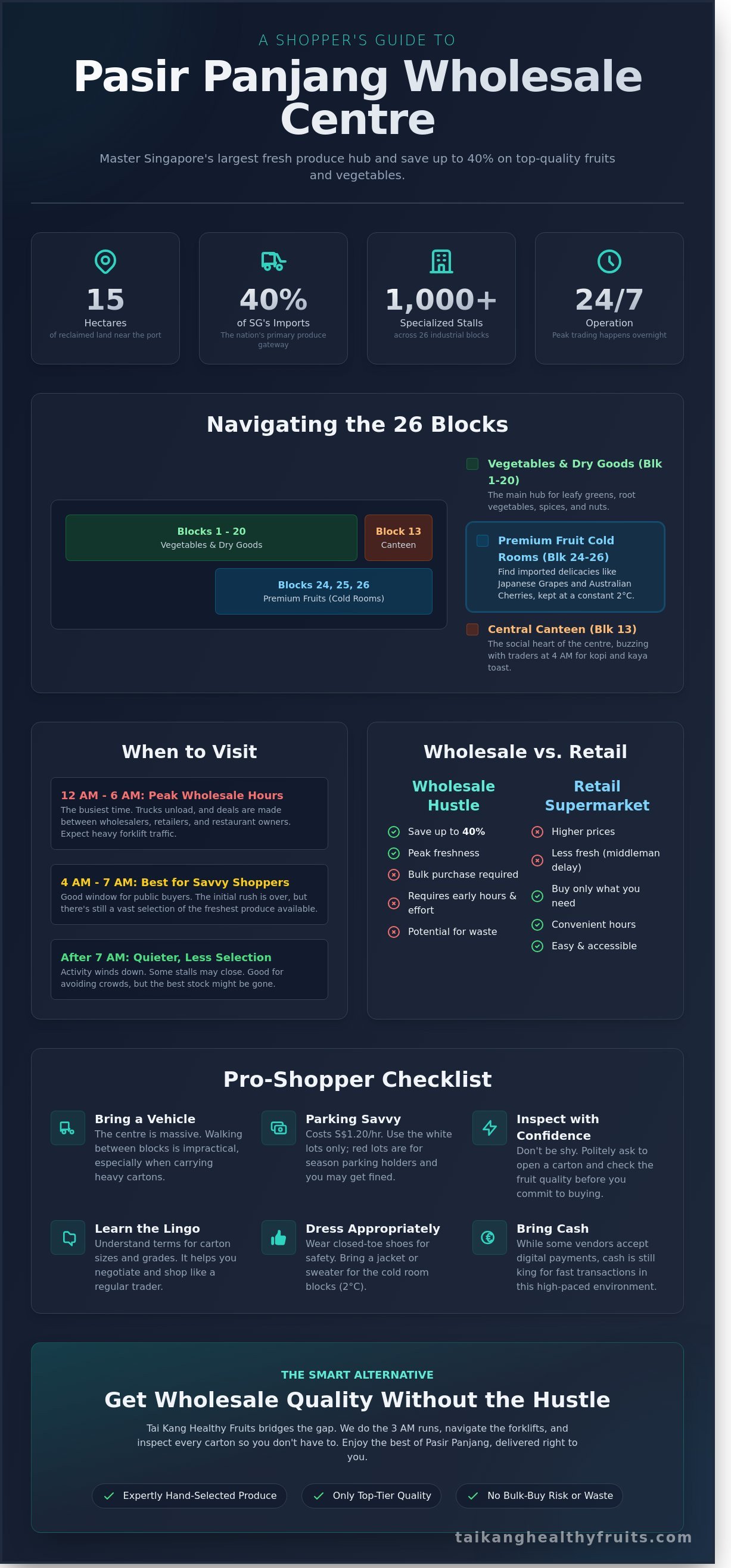
The pasir panjang wholesale centre occupies 16 hectares of land near the West Coast Highway. It is a massive distribution hub. To understand its scale, look at the History of Pasir Panjang and how it consolidated various regional markets into this single site in 1974. The facility contains 26 blocks organized in a grid. Each zone has a specific function. Blocks 1 through 20 primarily handle vegetables and dry goods. If you seek premium fruits, focus on the cold room blocks. Blocks 24, 25, and 26 are equipped with heavy duty refrigeration. These units keep delicate items like Korean strawberries, Australian cherries, and Japanese grapes at a steady 2 degrees Celsius. The air here is noticeably colder. It's a stark contrast to the humid tropical heat outside.
Logistics require a vehicle. Walking between blocks is impractical and tiring. Parking for cars costs S$1.20 per hour. You must park in white lots. Red lots are strictly for season parking holders. Most buyers drive from block to block to collect their crates. Between the frantic trading, visit the central canteen at Block 13. It is a legendary spot. Traders gather there at 4 AM for hot kopi and kaya toast. It provides a rare glimpse into the raw energy of Singapore's food supply chain. The atmosphere is loud, busy, and authentic.
Best Times to Visit for Public Shoppers
The gates stay open 24 hours a day, but the 24/7 label is misleading. Individual stalls set their own hours. Peak wholesale hours run from 12 AM to 6 AM. This is when large retailers and wet market owners buy in bulk. Casual shoppers should visit between 7 AM and 11 AM. The crowd thins out then. Wholesalers are more likely to sell single cartons or smaller bundles during these hours. Monday mornings are the quietest. Many stalls close or operate with limited stock because Sunday is a rest day for many shipping ports. You'll find the freshest arrivals on Tuesdays and Fridays.
Safety and Etiquette in a High-Traffic Zone
Safety is a serious concern. Forklifts are the kings of the road at the pasir panjang wholesale centre. They move quickly. They have the right of way. Always stay alert. Never block the path of a moving forklift. Dress for a warehouse environment. Closed-toe shoes are non-negotiable. The floors can be wet and slippery from crushed ice and vegetable remains. Light, breathable clothing helps you stay cool in the non-air-conditioned blocks.
Cash is still the primary currency. Many wholesalers don't accept credit cards or digital wallets. Bring plenty of S$10 and S$50 notes. Smaller denominations help speed up transactions. If you prefer a more controlled environment without the noise and heavy machinery, you can browse a quality selection of healthy fruits from the comfort of your home. This allows you to skip the 4 AM wake-up call while still getting fresh produce delivered to your doorstep. It's a transparent way to shop without the chaos of the wholesale floor.
Wholesale vs. Retail: Is a Trip to Pasir Panjang Worth It?
Buying in bulk at the pasir panjang wholesale centre offers a clear price advantage for specific shoppers. You can often save 30% to 40% compared to supermarket retail prices. For example, a carton of 88 Fuji apples might cost S$45 at the centre. The same quantity at a premium grocery store can exceed S$70. This price gap exists because you bypass retail packaging, shelf-stocking labor, and air-conditioning costs. However, the "Bulk Buy" trap is a frequent mistake for families. Saving 20% on a crate of berries is not a deal if 40% of the fruit spoils before your family can eat it. Most Singaporean households cannot consume 12 punnets of strawberries within three days. Waste turns a bargain into an expensive error.
Quality tiers are another critical factor to understand. Wholesalers categorize produce into "Class 1" export grade and "Commercial" grade. Class 1 fruit is uniform in size, color, and sugar content. Commercial grade fruit is often smaller or has minor skin blemishes. It works well for juicing or baking, but it lacks the visual appeal required for gifting. To understand the scale of this operation, consider the official management transfer that streamlined Singapore's food supply logistics. This hub is vital for national food security, yet it operates on industrial standards rather than retail comfort.
Hidden costs often erode your perceived savings. A round trip from Tampines to the pasir panjang wholesale centre can cost S$12 in fuel and S$4 in ERP charges. Parking fees add another S$2 to the bill. If you visit during peak wholesale hours at 3 AM, the cost to your sleep and productivity is significant. For many, these expenses and the time spent total over S$30 in value. This often negates the S$15 saved on a box of oranges.
The Premium Fruit Challenge: Japanese Melons and Grapes
Finding a single, perfect Japanese Musk Melon is harder at a wholesale warehouse than at a retail boutique. Wholesalers prioritize pallet movement over individual fruit care. They handle luxury items with the same speed as bulk commodities like potatoes. Fragile Korean Strawberries often sit in high-humidity cold rooms. This environment can cause rapid mold growth if the cold chain breaks for even ten minutes. You cannot easily inspect every berry in a sealed carton without disrupting the seller's workflow. Retailers provide individual inspection; wholesalers provide volume.
When to Choose Wholesale and When to Choose Delivery
The pasir panjang wholesale centre is the ideal choice for large-scale needs. Use it for Chinese New Year preparation, wedding catering, or neighborhood group buys. It's the best place for high-turnover items like lemons or onions. Delivery services are superior for daily nutrition, corporate gifting, and premium gift boxes. Professional delivery ensures your fruit arrives without bruises, without heat stress, and without the hassle of a cross-island drive. While the market offers a raw, industrial hustle; the online boutique offers a curated, stress-free experience. Tai Kang focuses on purity, safety, and the intrinsic value of quality produce.
- Choose Wholesale: For parties of 20+ people or monthly dry-storage stocking.
- Choose Delivery: For weekly fresh fruit, office snacks, and doorstep convenience.
- Choose Quality: Always prioritize Class 1 produce to ensure the highest nutrient density.
Pro Tips for Buying the Freshest Fruit at PPWC
Navigating the 26 sprawling blocks of the pasir panjang wholesale centre requires more than just a shopping list. It requires a specific strategy to ensure you leave with the best value. Regular traders and experienced home cooks use specific "Wholesale Lingo" to secure better deals. If you ask for the "carton price" instead of the "per kilo price," you signal that you understand the volume-based nature of the market. Establishing a rapport with the "Uncles" who manage the stalls is equally vital. A friendly greeting and a consistent presence can lead to a S$2 to S$5 discount on your subsequent visits. These sellers prioritize long-term loyalty over one-time transactions.
You must inspect every purchase with a critical eye. Wholesale fruit is often packed tightly for transport. This means the bottom layer of a carton bears the weight of everything above it. Always lift the top layers or reach down to check for hidden bruises, mold, or moisture at the base of the box. If you see juice staining the bottom of the cardboard, the batch is likely overripe or damaged. Quality varies significantly between shipments arriving at 3:00 AM and those that have been sitting in the humidity by 10:00 AM. Checking the "pack date" stamped on the side of the crate is a reliable way to verify freshness.
Seasonal awareness is your best tool for saving money and finding flavor. Australia provides premium citrus and stone fruits from November through February. Meanwhile, Japan and Korea export high-quality strawberries and grapes during the cooler months from December to March. Knowing these cycles ensures you don't pay premium prices for fruit that has been sitting in cold storage for too long. Freshly landed "in-flight" produce always commands a higher price but offers a superior taste that sea-freighted items can't match.
Spotting the Best Seasonal Arrivals
It's helpful to monitor new arrivals trends to see what produce is currently at its peak. When you walk through the fruit blocks, use your senses to guide your choices. A ripe Thai Honey Mango should emit a sweet, floral aroma near the stem. Avocados should feel firm but yield slightly to gentle thumb pressure. The very air in the warehouse often tells you which block received a fresh shipment of citrus or berries that morning. If you can't smell the fruit from a meter away, it likely isn't ready for consumption.
The Art of the Group Buy
Buying in bulk is the most effective way to make a trip to the pasir panjang wholesale centre economically viable. Many families now coordinate with neighbors to split a 5kg or 10kg carton of Shine Muscat Grapes or premium cherries. This "breaking bulk" process should happen quickly in a cool environment to prevent the fruit from sweating and spoiling. A successful group buy can reduce your cost per kilogram by 25% to 40% compared to local retail supermarkets. It's an efficient way to access high-end produce that might otherwise be outside a single household's weekly budget.
Ready to enjoy premium quality without the warehouse crowds? Shop our curated fruit selection today.
Tai Kang Healthy Fruits: The Curated Wholesale Experience
While the pasir panjang wholesale centre serves as the engine of Singapore's fruit trade, it isn't always the most practical destination for every shopper. Tai Kang Healthy Fruits bridges this gap by acting as your expert curator. Our team arrives at the docks during the early hours to hand-select the top 5% of every shipment. We understand that the average consumer doesn't want to navigate heavy machinery or buy 10 kilograms of a single fruit just to get a wholesale price. We provide the same freshness found at the source but with a layer of professional scrutiny that ensures only the finest specimens reach your table.
Our quality control process is rigorous and transparent. Every piece of fruit undergoes a three-point inspection before it's packed. We check for skin integrity, weight consistency, and brix levels to ensure peak sweetness. We reject crates with minor bruising or inconsistent sizing that the average shopper might miss in the dim light of a warehouse. This meticulous approach means you don't have to worry about the "luck of the draw" often associated with bulk buying. You get the luxury of Yamanashi Peaches from Japan or premium Australian Mandarins without the 3 AM wake-up call or the logistics of heavy lifting.
We specialize in the "Best of the Best" by maintaining direct relationships with global growers. Our inventory isn't just about volume; it's about variety and grade. Whether it's the crisp texture of USA Autumn Crisp grapes or the fragrance of Malaysian Mao Shan Wang, we ensure the cold chain remains unbroken from the moment the fruit leaves the farm until it arrives at your doorstep. This level of care preserves the vitamins and natural sugars that can degrade in the heat of a traditional market environment.
Corporate Wellness and Premium Gifting
Raw wholesale cartons work for industrial kitchens, but they don't meet the standards of a modern office. In 2023, 78% of our corporate partners shifted from bulk crates to our curated wellness boxes. These boxes prioritize presentation and branding, making them ideal for staff appreciation. We offer customization options for get-well-soon hampers and corporate events, ensuring every gift reflects your professional standards. Each box is packed to prevent transit damage, so the fruit arrives looking as perfect as it tastes.
Your Direct Link to Freshness
You can skip the forklifts and the exhaust fumes of the industrial zones. Browse our seasonal collection today to see the difference curation makes. Our "hand-selected" promise means every S$50 spent yields 100% edible, premium produce. At the pasir panjang wholesale centre, you might save a few dollars on a large carton, but shoppers often report a 15% loss due to spoilage or over-ripening in bulk lots. We eliminate that waste by delivering exactly what you need at its peak. Freshness is a right, but convenience is a choice. We make that choice easy by bringing the world's finest harvests directly to your home or office.
Secure Your Premium Harvest Today
Navigating the 26 blocks of the pasir panjang wholesale centre is a rewarding challenge for any food lover in Singapore. You've learned how to time your visit for the 2:00 AM peak and how to distinguish between bulk wholesale and retail-friendly stalls. It's clear that quality and freshness are the top priorities when exploring these 600 plus vendors. While the physical market offers an unmatched scale, finding the absolute best Japanese and Korean imports requires a discerning eye and years of industry expertise.
Tai Kang Healthy Fruits has provided that expert curation since we established our brand in 2020. We specialize in hand-selected seasonal fruits, focusing on purity and natural flavor. You don't have to worry about preservatives or artificial colors. Our team manages the logistics so you can enjoy boutique-level produce at home. Whether you're looking for crisp Korean pears or sweet Japanese strawberries, we ensure every delivery meets our high standards for safety and taste.
Get the freshest premium fruits delivered to your door; Shop Tai Kang now!
Enjoy the convenience of world-class fruit delivered with care and transparency.
Frequently Asked Questions
Can members of the public buy from Pasir Panjang Wholesale Centre?
Yes, members of the public can shop at the centre. While the facility primarily serves 1,000 commercial tenants and B2B buyers, individual walk-in customers are welcome to purchase fresh produce. You'll find a massive variety of fruits and vegetables across the 26-hectare site. It's a popular spot for families who want to stock up on fresh items for the week.
What are the best hours to visit Pasir Panjang Wholesale Centre for fresh fruit?
The best time to visit for fresh fruit is between 7:00 AM and 10:00 AM. While the market operates 24 hours, the bulk of commercial trading happens between midnight and 6:00 AM. Arriving by 8:00 AM ensures you get the pick of the morning's arrivals before many stalls begin closing at noon. Many fruit sellers offer their best retail prices during these mid-morning hours.
Do I need to buy in bulk at the wholesale centre?
You don't always need to buy in massive quantities, though most sellers prefer selling by the carton or crate. For example, grapes are often sold in 5kg boxes rather than individual 500g punnets. Buying in these larger units is how you access wholesale rates. Some stalls in the retail sections allow smaller portions, but the biggest savings come from purchasing at least one full original packing unit.
Is there an entrance fee or ERP for Pasir Panjang Wholesale Centre?
There's no entrance fee for visitors, but you'll need to pay for parking via the Electronic Road Pricing (ERP) system. Rates typically start at S$1.20 per hour for cars during peak hours. If you're driving, be prepared for heavy vehicle traffic. The gantries operate 24/7, so ensure your CashCard has a minimum balance of S$10.00 to cover potential parking and entry costs without any delays.
How do I get to Pasir Panjang Wholesale Centre via public transport?
You can reach the pasir panjang wholesale centre by taking the Circle Line to Haw Par Villa MRT Station. From Exit A, board bus 175 or 176 and alight two stops later at the Wholesale Centre bus stop. The walk from the bus stop to the main trading blocks takes about 5 minutes. It's a convenient route for those who want to avoid the S$1.20 hourly parking fees and heavy traffic.
What should I wear when visiting the wholesale market?
Wear comfortable, non-slip covered shoes and light clothing. The market floors are often wet from melted ice and cleaning, so flip-flops aren't safe. Since you'll be walking across a 26-hectare facility, sturdy sneakers are the best choice. Avoid white clothing as the environment is industrial. You'll likely be dodging forklifts and pallet jacks, so visibility and mobility are your top priorities for a safe visit.
Are prices at Pasir Panjang Wholesale Centre significantly cheaper than NTUC or Cold Storage?
Prices at the pasir panjang wholesale centre are typically 30% to 50% lower than major supermarkets like NTUC FairPrice or Cold Storage. For instance, a box of 12 Fuji apples might cost S$10.00 here, while the same quantity at a supermarket could exceed S$18.00. These savings are possible because you're buying closer to the source and skipping the retail packaging and cooling costs of premium shopping malls.
Is the produce at the wholesale centre safer than at a wet market?
The produce here is just as safe as wet markets because all items must meet Singapore Food Agency (SFA) standards. In fact, the high turnover rate means fruit often spends less time in storage. Over 90% of Singapore's imported fruits pass through this hub. You get fresh, transparent quality directly from the importers. This ensures your family consumes produce that hasn't been sitting on a retail shelf for several days.