
Country of Origin Labels: What Businesses Must Know
Most packaged food sold at retail must display a country-of-origin label, and the exact rule depends on your product type, packaging, and sales channel. A “Product of [Country]” claim means every significant ingredient and processing step happened there; “Grown in [Country]” or “Made in [Country]” carries its own narrower test depending on the jurisdiction. If you sell food commercially, your next move is simple:
- Identify whether your product is packaged or unpackaged, and whether it counts as a priority food.
- Check your sales channel (supermarket, online store, farmers market, or vending machine) since each carries different obligations.
- Run your product through an official country of origin labelling checklist before you print a single label.
Skipping that check is how businesses end up reprinting thousands of labels after a retailer rejects a shipment.
Key Takeaways
Compliant country-of-origin labeling depends on matching the correct format to your product category and backing every claim with retained shipping and supplier documentation.
| Point | Details |
|---|---|
| Confirm scope first | Check whether your product is packaged, unpackaged, or a priority food before choosing a label format. |
| Match the format | Use the standard mark for priority foods and a plain statement for non-priority or imported goods. |
| Verify substantial transformation | Repackaging alone rarely qualifies a product for a new country-of-origin claim. |
| Keep paper trails | Retain invoices and bills of lading for at least a year to back every origin statement. |
| Update listings on arrival | Refresh online product pages the moment sourcing shifts to a new supplier or region. |
Table of Contents
- Which foods need a country of origin label
- What formats do compliant origin labels take?
- How to create and display a compliant label
- Proving origin: documents and traceability for imported goods
- Who enforces origin labeling rules, and where to get help
- A practical origin-labeling checklist for fruit sellers
- Where country of origin labels came from and why they still matter
- Why shoppers actually care about origin claims
- How origin labeling rules differ by market
- What trips businesses up on origin labeling
- Where origin labeling regulation is headed
- Our take: compliance is a habit, not a form you fill out once
- Bring Your Labeling Practice Up to Standard
- Sources
Which foods need a country of origin label
Not every product on a shelf needs the same treatment. Packaged retail food is where most obligations live, but unpackaged goods sold loose, like fruit at a market stall, often need a sign or ticket rather than a printed label. Food sold at the point where it was made, such as a bakery selling bread on-site, sometimes falls outside the standard requirement entirely.
- Priority foods first. Categories like fresh fruit, vegetables, seafood, meat, and nuts typically carry the strictest rules because they’re minimally processed and their origin is easy to verify.
- Packaged vs. unpackaged. A bagged apple in a supermarket needs a compliant label; the same apple sold loose from a bin usually needs a nearby sign instead.
- Sales channel matters. A product sold through a supermarket, an online store, a market stall, or a vending machine can trigger different labeling formats even when the food itself is identical.
- Non-retail sales. Food sold directly to a restaurant or another business, rather than to the end consumer, is often governed by separate rules than retail packaging.
Regulators built interactive tools specifically because these boundaries confuse business owners constantly. The business.gov.au labelling tool walks you through product type, packaging status, and sales channel to spit out a definitive answer rather than a guess. If you’re selling packaged fresh fruit online, run it through before you finalize artwork. It’s a five-minute check against a very expensive mistake.
What formats do compliant origin labels take?
Regulators accept a handful of formats, and using the wrong one for your product category is one of the most common compliance failures.
- The standard mark: a boxed graphic combining a kangaroo or similar national symbol, a bar chart showing the percentage of local ingredients, and a text statement. This format is mandatory for many priority foods sold in Australia and similar markets, and it’s the most visually recognizable label type on supermarket shelves.
- The country of origin statement: a plain text line, such as “Made in Thailand from local and imported ingredients,” used for non-priority foods or many imported goods where the bar chart format doesn’t apply.
- Percentage bar charts: these appear inside the standard mark to show what proportion of ingredients, by weight, came from the claimed country. Regulators describe accepted formats and rules in detail, including how priority and non-priority foods differ.
- Abbreviations and legibility: origin statements generally can’t be abbreviated to the point of ambiguity, must sit inside a clearly defined box or border where required, and need to be legible at normal reading distance, not buried in six-point type on the back panel.
Getting the format wrong doesn’t just risk a fine. It confuses shoppers who’ve learned to scan for the standard mark specifically, and a plain text statement in the wrong spot can look like you’re hiding something even when you aren’t.
How to create and display a compliant label
Building a compliant label is a sequence, not a single decision. Skip a step and you’ll likely be reprinting.
- Determine your inputs. List every ingredient and its country of origin before you draft any wording.
- Confirm substantial transformation. If your product was processed in a different country from where the raw ingredients came from, figure out whether that processing counts as a “substantial transformation” under your jurisdiction’s rules. This determines whether you can claim “Made in” the processing country at all.
- Pick the correct claim format. Match your product category to standard mark, statement, or bar chart requirements based on whether it’s a priority food.
- Check size and placement rules. Standard marks typically need minimum dimensions and a defined position on the principal display panel; master cartons often carry different rules than individual retail units.
- Pull an official template. Government pages commonly publish downloadable EPS or PDF templates built to the exact proportions regulators expect, which removes most of the guesswork around spacing and symbol accuracy.
- Handle mixed-origin products correctly. A gift box with strawberries from one country and citrus from another needs wording like “Packed in [Country] from local and imported produce” rather than a single blanket origin claim.
Pro Tip: Proof your label at full size before it goes to print, not on a screen. Small text that looks fine zoomed in on a monitor often becomes illegible at the actual label size, and that’s exactly the kind of legibility failure inspectors flag first.
Master cartons used for bulk imports often carry the origin declaration for the whole shipment, while individual consumer-facing units still need their own compliant label once repackaged for retail sale.
Proving origin: documents and traceability for imported goods
Regulators and retailers both expect paper trails, not just printed claims. The documents that actually prove where a product came from are commercial invoices, bills of lading, and shipping manifests, since these get generated independently of your marketing and are harder to fake convincingly.
- Commercial invoices should specify country of origin per line item, not just a shipment total.
- Bills of lading confirm the shipping route and originating port, which auditors cross-reference against label claims.
- Master carton declarations are acceptable for bulk goods still in transit, but once you break a shipment down into individual retail units, each one typically needs its own compliant label.
- Commingled lots (multiple origins in a single batch) require wording that reflects the mix accurately rather than a simplified claim for whichever origin makes up the majority.
Retailer audit cycles vary, but a widely cited labeling manual recommends retaining origin documentation for at least a full year, since retailers frequently request records well after a shipment has already sold through.
Who enforces origin labeling rules, and where to get help
Enforcement bodies differ by market, but their expectations rhyme. In Australia, the ACCC investigates misleading origin claims and can pursue penalties for false statements. In the United States, the USDA’s Agricultural Marketing Service administers Country of Origin Labeling (COOL) for covered commodities like fresh produce, certain meat cuts, fish, and nuts. In the UK, marketing standards enforced under Gov require country of origin in full on fresh produce packaging, alongside fields like quality class and packer code.
- Common enforcement triggers include vague claims (“Product of Various Countries” without specifics), mismatched labels versus invoices, and undersized or illegible standard marks.
- Official resources worth bookmarking include regulator label generators, downloadable style guides, and industry labeling manuals rather than third-party summaries that go stale.
- When to escalate: if your product straddles categories (partly processed, partly imported, partly repackaged), request a formal ruling from the relevant regulator rather than guessing. A written ruling is your best defense if questioned later.
Small operators sometimes assume enforcement only targets large importers. In practice, inspectors respond to complaints, and a single mismatched invoice is often enough to trigger a review regardless of company size.
A practical origin-labeling checklist for fruit sellers
Turning regulation into a routine is what actually prevents violations, not reading the rules once and hoping you remembered correctly.
- Collect supplier declarations for every batch, specifying exact country of origin, before the shipment even arrives.
- Retain invoices and bills of lading for at least a year, ideally in a searchable digital archive rather than a filing cabinet.
- Proof every label before print, checking wording against the actual shipment documents, not against last month’s template.
- Update online listings the moment a delivery arrives, especially for products where origin shifts seasonally between suppliers.
Tai Kang Healthy Fruits builds this discipline into daily operations: every shipment goes through inspection and temperature-controlled storage before it reaches a customer, which is the same rigor that supports an accurate origin claim, not just a fresher piece of fruit. A high customer rating reflects a business that treats “what you see is what you get” as an operating principle, not a slogan.
When a gift box contains strawberries from one country and citrus from another, don’t hide the mix behind a single flag icon. Say plainly that it’s “packed from local and imported produce,” because a transparent multi-origin statement builds more trust than a claim that oversimplifies.
Where country of origin labels came from and why they still matter
Origin labeling didn’t start as a consumer-protection measure. Early rules in the late 19th and early 20th centuries were built mainly to protect domestic producers from underpriced imports, giving buyers a way to identify (and often avoid) foreign goods during periods of trade protectionism. The food-specific version of these laws grew out of a different concern: safety. As global supply chains lengthened through the 20th century, regulators needed a way to trace contaminated shipments back to a source quickly, and origin claims became part of that traceability infrastructure.
Modern rules layer a third purpose on top of the first two: informed choice. Today’s frameworks, from the standard mark system to COOL to EU/UK marketing standards, exist so a shopper can make a values-based decision, whether that’s supporting local growers, avoiding a specific region during a food-safety scare, or simply preferring the flavor profile of fruit grown in a particular climate.
That layered history explains why the rules feel inconsistent across product categories. A rule built for meat traceability doesn’t map cleanly onto fresh fruit, and a rule built for anti-dumping protection doesn’t map cleanly onto a shopper’s curiosity about flavor. Businesses inherit all three purposes at once, which is part of why the compliance landscape feels more tangled than it should.
Why shoppers actually care about origin claims
Origin labels change buying behavior more than most businesses assume. Consumer research on origin claims consistently finds that transparent origin information shapes perceptions of quality and sustainability, not just where a product physically came from. A clearly labeled “Grown in [Country]” claim can read as a proxy for freshness, shorter transit time, and even ethical sourcing, whether or not that inference is strictly accurate.
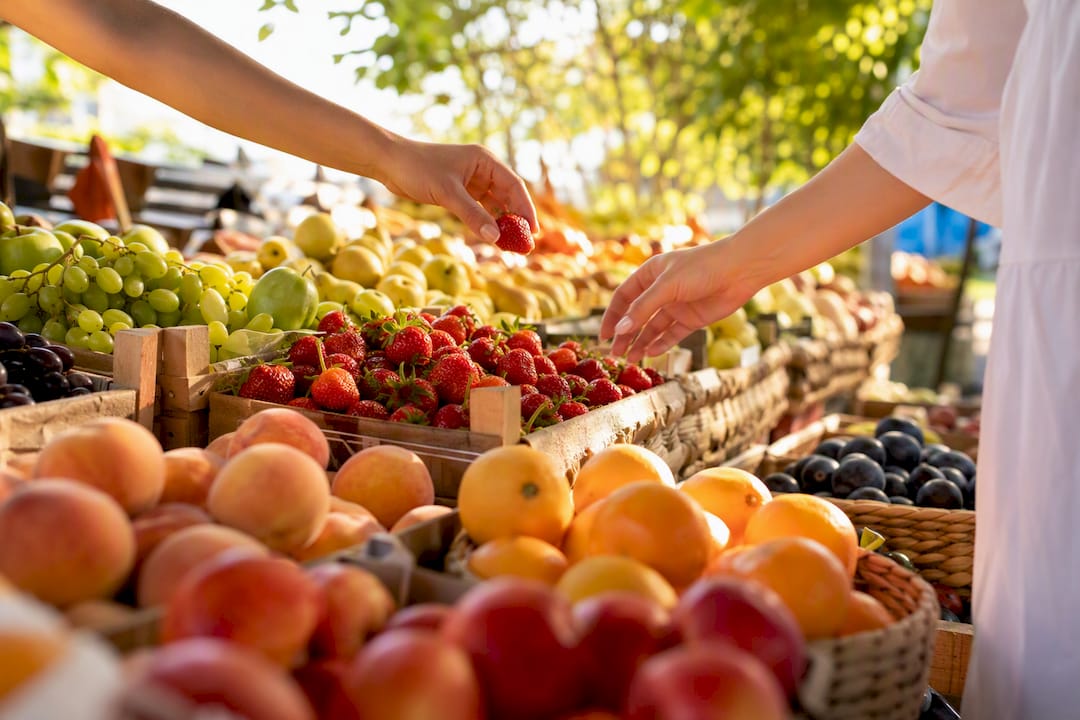
This creates a real opportunity and a real risk simultaneously. An accurate, prominent origin claim is a legitimate marketing asset. Fruit sellers who source seasonally and label honestly can lean into that story rather than treating the label as a compliance afterthought. But the same research cuts both ways: shoppers who feel misled by a vague or inflated origin claim tend to generalize that distrust to the whole brand, not just the one product.
The practical takeaway for anyone selling fresh produce is that origin labeling sits at the intersection of legal obligation and brand voice. A supermarket customer scanning for a standard mark isn’t just checking a compliance box in their own head. They’re deciding, often unconsciously, whether they trust the business enough to buy again. Get the label right and you’ve done more than avoid a fine. You’ve answered a question the shopper was already asking.
How origin labeling rules differ by market
There’s no single global standard, and that’s the source of most cross-border headaches. Australia’s system centers on the standard mark and country-of-origin statement, with priority foods facing the strictest bar-chart requirements. The United States runs on COOL, which applies to a defined list of covered commodities, fresh produce, certain meat cuts, fish, and nuts, administered by the USDA’s Agricultural Marketing Service, and the retailer-facing display rules differ from the wording rules used elsewhere.
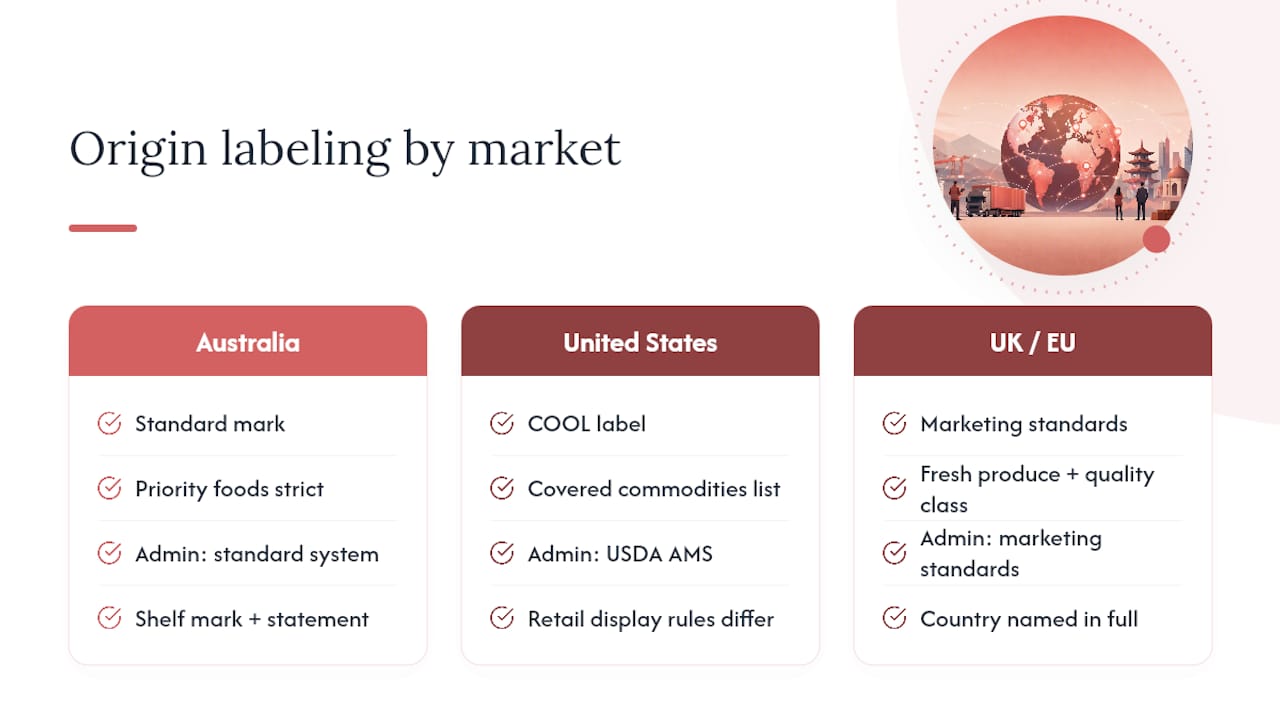
The UK and EU take yet another approach through fresh produce marketing standards, which mandate country of origin in full alongside quality class and packer or dispatcher identification on the pack. That “in full” requirement is stricter in one specific way: abbreviations that might pass elsewhere often don’t satisfy UK marketing standards for fresh fruit and vegetables.
For a business sourcing or selling across more than one of these markets, the practical implication is that you cannot reuse one label design everywhere. A standard mark built for Australian shelf compliance won’t satisfy US COOL display rules, and neither will satisfy the UK’s full-name requirement without modification. Businesses that sell internationally usually maintain separate label templates per market rather than trying to force one universal design to clear every jurisdiction’s bar.
What trips businesses up on origin labeling
The same handful of mistakes recur across almost every enforcement case worth reading about. Substantial transformation is the biggest one: businesses assume that repackaging or lightly processing an imported product in a new country lets them claim that country as the origin, when most frameworks require a genuine transformation, not just a change of packaging.
Mixed-origin products cause the second most common headache. A fruit basket with produce from three countries doesn’t fit neatly into a single-origin claim, and businesses often default to whichever country makes up the largest share, which can misrepresent the rest of the contents.
Documentation gaps are the third recurring problem, and they’re the easiest to fix. A business might label correctly at the point of packaging but fail to retain the invoice or bill of lading that would prove the claim during an audit months later. Seasonal sourcing changes compound this: a supplier switch mid-season means last month’s label wording may already be inaccurate for this month’s stock, and businesses that don’t update listings promptly end up selling under a stale claim without realizing it.
Small and mid-sized sellers face a specific version of this problem: they often lack a dedicated compliance function, so labeling decisions get made ad hoc by whoever is packing that day’s shipment, with no consistent review before print.
Where origin labeling regulation is headed
Expect two forces to reshape origin labeling over the next several years: tighter substantial-transformation scrutiny and rising demand for verifiable, not just declared, origin. Regulators in multiple markets have been narrowing what counts as a genuine transformation, closing the loophole where light repackaging alone justified a new country claim.
Technology is starting to close the verification gap that paper documentation leaves open. QR codes linking to batch-level origin and supply-chain data are appearing on premium produce packaging, letting a shopper trace a piece of fruit back further than a printed label ever could. Blockchain-based traceability pilots aim at the same problem from the supply-chain side, creating a tamper-resistant record that auditors and retailers can check against a business’s printed claims.
Sustainability is also merging with origin messaging in ways regulators haven’t fully caught up with yet. As recyclable and eco-friendly packaging becomes a competitive expectation rather than a niche feature, expect origin claims and packaging-sustainability claims to start appearing on the same label, and expect regulators to eventually apply the same rigor to both. Businesses that build documentation habits now, treating every origin claim as something they’d need to prove on short notice, will adapt to whatever comes next far more easily than those still treating labeling as a once-a-year printing decision.
Our take: compliance is a habit, not a form you fill out once
The conventional advice on origin labeling treats it like a one-time legal hurdle: check the box, print the label, move on. That framing misses what actually causes violations. Most enforcement cases aren’t businesses deliberately lying about origin. They’re businesses that labeled correctly once and then let sourcing, packaging, or documentation drift out of sync with that original claim.
What gets underestimated is how much origin accuracy depends on operational discipline elsewhere in the business, inspection routines, invoice retention, listing updates at the moment stock changes. A business that treats seasonal sourcing as a live variable rather than a set-it-and-forget-it detail will naturally keep its labels honest, because the people updating listings are the same people watching what’s actually arriving in each shipment.
If you take one thing from this guide, prioritize documentation over design. A beautifully formatted label backed by no paperwork is a liability. A plain, accurate statement backed by a clean invoice trail is a business that survives an audit without losing sleep.
— Tai
Bring Your Labeling Practice Up to Standard
Getting origin claims right isn’t just about avoiding a regulator’s letter. It’s about giving shoppers a reason to trust what’s on the label, which matters just as much for a fruit gift box as it does for a bag of loose apples. Tai Kang Healthy Fruits applies that same standard to every shipment: careful inspection, temperature-controlled storage, and clear communication about where each piece of fruit actually came from, whether it’s headed into a Fruitastic gift box or a weekly subscription order. If you want fruit sourced and handled the way this guide describes, explore what’s currently in season at Tai Kang Healthy Fruits and see the difference a documented, transparent supply chain actually makes.
Sources
- Business
- Country of origin food labelling | ACCC
- Country of Origin Labeling (COOL) | Agricultural Marketing Service
- Gov
Recommended
- How to Choose a Corporate Gift Supplier in 2026: The Ultimate Quality – Tai Kang Healthy Fruits
- Avoiding Bad Fruit from the Supermarket: A 2026 Guide to Freshness – Tai Kang Healthy Fruits
- Premium Fruit Gift Box Singapore: The 2026 Luxury Gifting Guide – Tai Kang Healthy Fruits
- What Makes Japanese Fruits So Expensive? The Secrets of Luxury Produce – Tai Kang Healthy Fruits