
50–240 mL for Juice, and Why Whole Fruit Still Wins in Singapore
Choose whole fruit by default. It fills you up faster, delivers fiber that juice loses in processing, and keeps sugar intake at levels your body handles well. A small glass of 100% fruit juice can still fit a balanced diet, but treat it as an occasional stand in, not a daily habit, and skip juice-only cleanses entirely.
TL;DR:
- Whole fruit provides fiber and bulk that promote satiety and slow sugar absorption, making it more satisfying and nutritionally complete than juice.
- Drinking more than 125 to 240 mL of 100% juice daily may increase BMI in children and offers limited benefits for adults.
- Moderate juice consumption of 50 to 240 milliliters per day can support nutrient intake but exceeds this amount may pose health risks, especially for diabetics and at-risk groups.
- Juice production involves resource-intensive steps like concentrating and packaging, making whole fruit a more environmentally sustainable option.
- Choosing whole fruit over juice helps support gut microbiome health, as fiber in whole fruit feeds beneficial gut bacteria and fosters microbial diversity.
Table of Contents
- Fruit vs Fruit Juice: What Changes When You Juice It
- Does Fruit Juice Fill You Up Like Whole Fruit Does?
- What Do Long-Term Studies Say About Juice, Diabetes, and Heart Disease?
- What Do WHO and Singapore’s HPB Recommend for Juice Servings?
- Your Practical Decision Rule for Fruit vs Fruit Juice
- Why Trust This Guidance on Fruit vs Fruit Juice?
- Does Juicing Fruit Change Your Gut Bacteria?
- Does Fruit Juice Hydrate You Better Than Whole Fruit?
- Which Has a Smaller Environmental Footprint: Fruit or Juice?
- Why Whole Fruit Deserves the Benefit of the Doubt
- Make Whole Fruit the Easy Choice, Not the Hard One
- Sources
- FAQ
Fruit vs Fruit Juice: What Changes When You Juice It
Juicing strips out most of the fiber, concentrates the sugar, and reduces the total volume of fruit you’d actually eat in one sitting. A 2025 peer-reviewed review concluded that whole fruit is generally the better default precisely because of what processing removes: fiber, some vitamins, and the physical bulk that makes you feel full. The same review found whole fruit produces measurably greater satiety per calorie than its juiced counterpart.
The sugar question is where most people get confused. The World Health Organization classifies sugars released from fruit during juicing as free sugars, the same category as table sugar added to a soda, even though the sugar started out inside a piece of fruit. Intact fruit, by contrast, contains intrinsic sugars locked inside plant cell walls, which slows how fast your gut absorbs them. That distinction is why an orange and a glass of orange juice get treated so differently on a nutrition label, even when they come from the same tree.
Vitamin and polyphenol losses compound the problem. Vitamin C degrades with light, heat, and oxygen exposure during juicing and storage, so a juice sitting on a shelf for weeks carries less than one pressed fresh that morning. Some polyphenols, the plant compounds tied to antioxidant activity, bind to fiber and get filtered out entirely during juice extraction.
Before buying a bottle, run through this quick label check:
- Confirm it says “100% juice,” not “fruit drink” or “juice cocktail,” which can contain added sugar and as little as 5 to 10% actual fruit content.
- Check whether it’s from concentrate or direct pressed. Reconstituted concentrate typically loses more volatile aroma compounds and some vitamin C during the concentration process.
- Scan the ingredient list for added sweeteners hiding under names like cane sugar, fructose, or fruit juice concentrate used as a sweetener rather than the primary juice.
Pro Tip: If a bottle lists “water” and “sugar” above the named fruit, you’re looking at a fruit drink, not fruit juice. Singapore’s food regulations explicitly define fruit juice and separate it from fruit drinks based on percent fruit content, so the label distinction actually carries legal weight, not just marketing language.
Does Fruit Juice Fill You Up Like Whole Fruit Does?
Chewing matters more than most people realize. It slows down eating, triggers early satiety signals in your gut, and gives your stomach time to register that food has arrived before you’ve finished a full portion. Juice skips that step. You can drink the sugar equivalent of three oranges in under a minute, something that would take several minutes of chewing and would likely leave you satisfied well before you got through all three pieces of fruit.
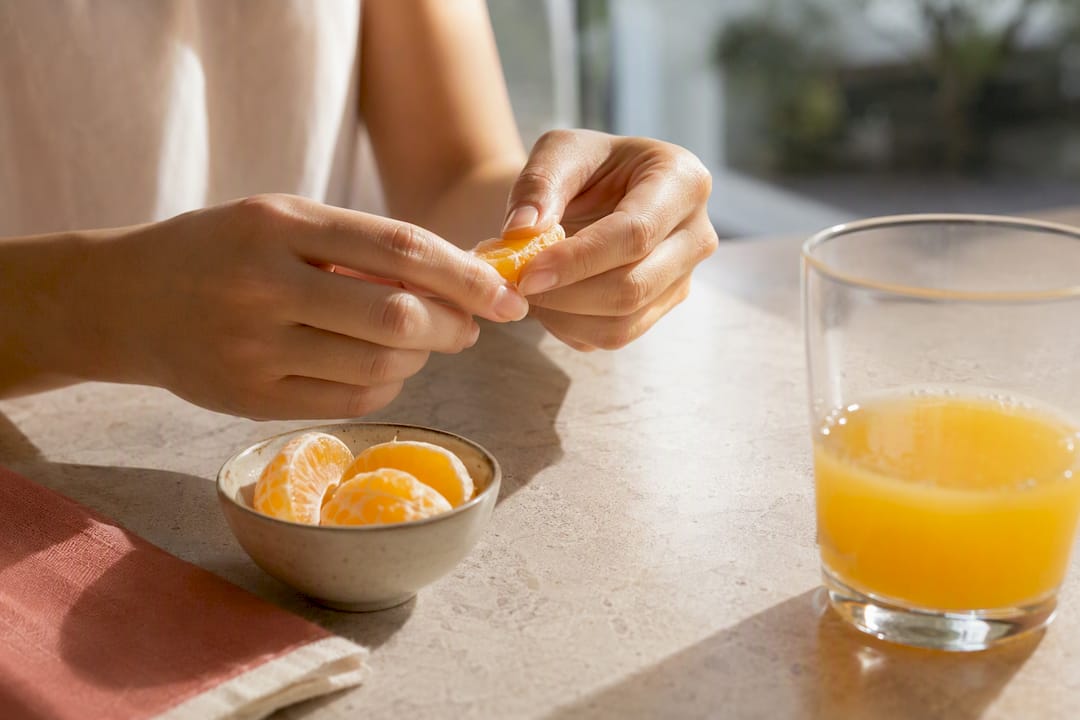
The “food matrix” is the technical term for this effect: the physical structure of whole fruit, its fiber network and cell walls, slows gastric emptying and blunts how fast sugar hits your bloodstream. Strip that structure away through juicing, and you lose the built-in portion control that whole fruit provides.
The evidence splits meaningfully by age group. A 2023 systematic review and meta-analysis covering 42 studies found that 100% juice intake in children was linked to small but consistent increases in BMI. Adult randomized trials in the same review showed mixed results, with no clear pattern connecting juice consumption to adult weight gain. Kids appear more vulnerable to the effect, possibly because juice displaces water or milk in a smaller daily calorie budget where every ounce counts more.
- For kids’ snacks and lunchboxes, whole fruit or a small fruit cup beats a juice box on the fullness front.
- For post-workout recovery, a small 100% juice serving can work fine since the goal is often rapid carbohydrate replacement, not fullness.
- For everyday adult snacking, whole fruit wins on staying power between meals.
Pro Tip: If you’re packing a kid’s lunch, swap the juice box for a piece of whole fruit and a water bottle at least a few days a week. It’s a small change that adds up over a school year.
What Do Long-Term Studies Say About Juice, Diabetes, and Heart Disease?
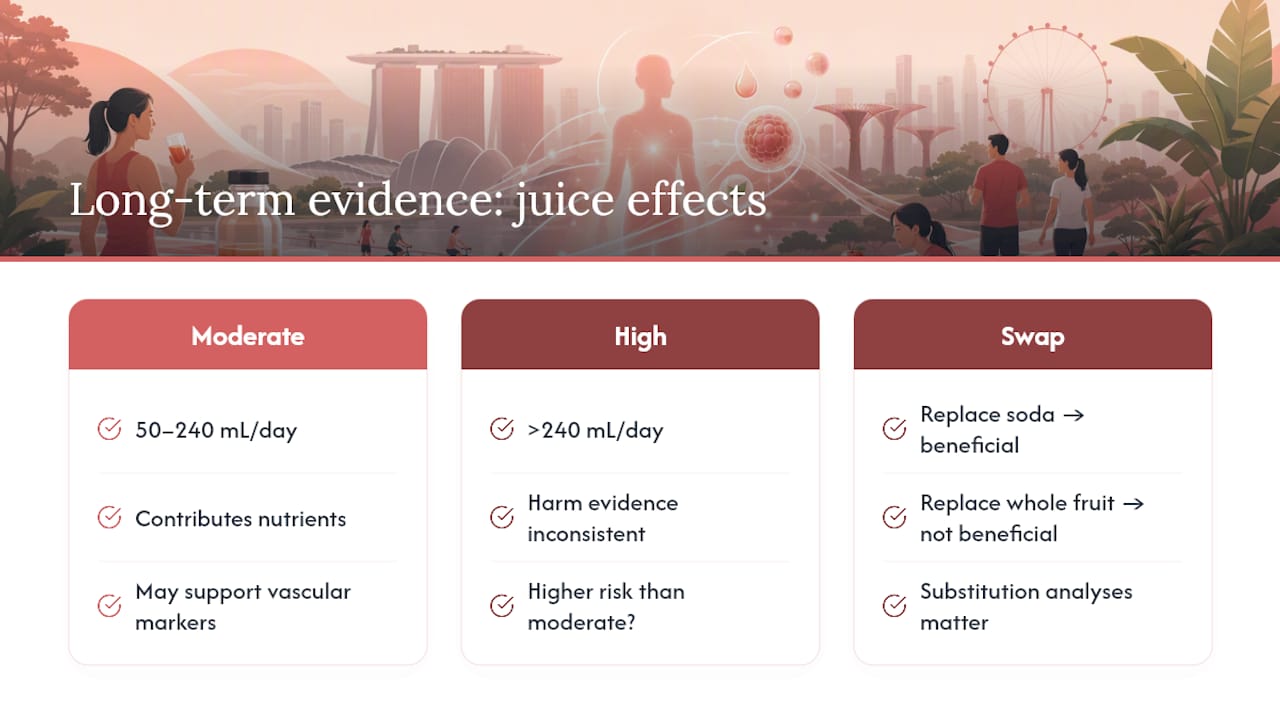
The picture here is more nuanced than “juice is bad.” An umbrella review of systematic reviews with meta-analyses found that moderate 100% juice intake, in the range of 50 to 240 milliliters a day, can supply nutrients and may support vascular health markers. High intakes above that range showed inconsistent evidence of harm across the reviewed studies, suggesting dose matters more than a blanket juice-good-or-bad framing.
Moderate 100% fruit juice intake sits in a genuinely different risk category than sugar-sweetened soda. The umbrella review’s authors note that at 50 to 240 mL per day, juice can contribute to nutrient adequacy and vascular benefits, a pattern that simply doesn’t hold at higher daily volumes or with sweetened juice drinks.
Cohort studies, which track large populations over years, and randomized controlled trials, which test direct interventions, don’t always agree here. Substitution analyses, where researchers model what happens when juice replaces water versus soda versus whole fruit, tend to matter more than the raw juice number alone. Swapping juice for soda looks like a win. Swapping whole fruit for juice usually doesn’t.
Certain groups should be more careful regardless of dose. Children, given the BMI association noted above, people already managing diabetes, since juice’s fast sugar absorption can spike blood glucose more sharply than whole fruit, and anyone at higher dental-caries risk, since liquid sugar bathes teeth differently than fruit eaten whole.
What Do WHO and Singapore’s HPB Recommend for Juice Servings?
Public health bodies converge on a similar answer: keep it small, and count it toward your daily sugar limit. The World Health Organization recommends free sugars stay under 10% of total daily energy, with additional benefit below 5%, roughly 25 grams a day for a typical adult diet. Since juice sugars count as free sugars, a single 250 mL glass of orange juice can eat up a meaningful chunk of that daily allowance on its own.
Singapore’s Health Promotion Board applies this thinking directly through its Nutri-Grade framework, which extends to freshly prepared beverages sold in cafes and hawker stalls, not just packaged drinks. The grading system nudges consumers toward lower-sugar choices even among 100% juices.
For practical serving sizes, follow this simple sequence, as explained in the guidance on portion control from Wild Foodz by Hotel Entree Brugge:
- Treat 125 to 240 mL (roughly a small to medium glass) as a reasonable upper limit for adult 100% juice servings on days you choose to drink it.
- Keep children’s juice servings smaller and less frequent, given the BMI association in younger age groups.
- Count that serving against your daily free-sugar budget rather than treating it as a separate, unlimited category.
Your Practical Decision Rule for Fruit vs Fruit Juice
Most days, the choice should be automatic: reach for whole fruit first. Save juice for situations where whole fruit isn’t practical, like a smoothie on a rushed morning or a small glass alongside breakfast.
Run through this sequence when deciding:
- Ask if whole fruit works for this moment. If yes, default to it, especially for snacks, lunchboxes, and anytime appetite control matters.
- If juice is the only convenient option, pick 100% juice over a fruit drink, and cap it around 125 to 240 mL.
- Never treat juice as a meal replacement or use it for a multi-day cleanse. Mayo Clinic’s guidance specifically questions the evidence behind juice cleanses and recommends blending over juicing when fiber preservation matters, since blending keeps the pulp intact.
- Compare fruit-equivalents, not fluid ounces. A single glass of juice can contain the squeezed contents of three or four oranges, sugar you’d never eat that fast as whole fruit.
Pro Tip: If you juice at home, drink it within a day or refrigerate it immediately. Mayo Clinic notes that bacteria can multiply quickly in freshly extracted juice, which is why pasteurized commercial juice is the safer choice for kids, pregnant women, older adults, and anyone with a weakened immune system.
Why Trust This Guidance on Fruit vs Fruit Juice?
This guide is built around peer-reviewed research, WHO and HPB public health guidance, and Mayo Clinic’s clinical recommendations, not marketing claims.
Want to go deeper on specific fruit choices? These guides expand on the topics above:
- High-fiber fruits available in Singapore, useful if you’re building fiber intake toward the 25-gram daily target.
- Fruits for gut health, with evidence-based picks and a two-week trial framework.
- How to wash fruit properly, which pairs well with the food-safety notes above.
Does Juicing Fruit Change Your Gut Bacteria?
Your gut microbiome depends heavily on fiber as fuel, and juicing removes most of it before the fruit ever reaches your mouth. Fiber that survives digestion in your small intestine travels to your colon, where bacteria ferment it into short-chain fatty acids that support gut lining health and feed beneficial microbial populations. Strip the fiber out through juicing, and that fermentation substrate mostly disappears.
Whole fruit’s structure also matters here beyond just fiber content. The plant cell walls and pulp in intact fruit slow digestion and create a more gradual release of both sugars and polyphenols as food moves through your gut, giving bacteria more contact time with fermentable material. Juice delivers sugar quickly to your upper digestive tract, where it’s absorbed well before reaching the colon, leaving little for gut bacteria to work with.
This doesn’t mean juice destroys gut health with a single glass. But a diet built consistently around juice instead of whole fruit likely means less fiber reaching your colon over time, which researchers increasingly connect to microbial diversity. If you’re specifically trying to support gut health through diet, whole fruit does more of the actual work than its juiced equivalent, largely because it still has the fiber matrix intact when it arrives where your gut bacteria live.
Does Fruit Juice Hydrate You Better Than Whole Fruit?
Juice contains more water by volume than the whole fruit it came from, since juicing extracts liquid and discards solid fiber. A cup of orange juice is almost entirely water and sugar, while a whole orange delivers roughly the same water content bound up with fiber, pulp, and a slower release into your system.
That doesn’t automatically make juice the better hydration choice. The sugar concentration in juice can actually slow fluid absorption compared to plain water or the water content in whole fruit, since your gut needs to manage that sugar load alongside the fluid. Whole fruits like watermelon, oranges, and cucumber (technically a fruit) deliver water gradually alongside electrolytes and fiber, without the concentrated sugar hit.
For everyday hydration, water remains the simplest answer, and whole fruit contributes meaningfully without adding a large free-sugar load to your day. Juice can supplement fluid intake in a pinch, but leaning on it as a primary hydration source means absorbing significant sugar to get there, a trade-off plain water and whole fruit both avoid.
Which Has a Smaller Environmental Footprint: Fruit or Juice?
Juice production adds processing steps that whole fruit skips entirely, and each step carries its own resource cost. Pressing, pasteurizing, concentrating, packaging, and often refrigerating juice through the supply chain all add energy and water use beyond what it takes to grow and ship whole fruit.
Concentrate production in particular strips water out of juice for shipping efficiency, then adds water back in at the bottling plant, an energy-intensive round trip that whole fruit never requires. Packaging is another factor: juice typically ships in cartons, bottles, or bags that add manufacturing and disposal considerations beyond the fruit’s natural peel or skin, which is often compostable or simply discarded as organic waste.
Whole fruit does still involve its own footprint through transport, refrigeration, and any food waste from spoilage. But it skips the extraction and concentration stages that make juice production more resource-intensive per serving of actual fruit consumed. For readers weighing sustainability alongside nutrition, whole fruit generally wins on both fronts, one more reason it makes sense as the everyday default rather than juice.
Why Whole Fruit Deserves the Benefit of the Doubt
People treat fruit juice like a shortcut to fruit’s benefits, but the research keeps pointing to the same gap: juice gives you the sugar and some of the vitamins, minus the fiber and the fullness that make whole fruit work as well as it does. That’s not an argument against juice entirely. It’s an argument for keeping it in its place, a small addition, not a substitute. Try swapping one juice serving a week for a piece of whole fruit and notice the difference in how long you stay satisfied.
— Tai Kang
Make Whole Fruit the Easy Choice, Not the Hard One
The purpose of this service is to help fill the gap this article just described: knowing whole fruit is the better default doesn’t help much if fresh, high-quality fruit isn’t readily available. Premium-grade fruit stored in temperature-controlled conditions and delivered to your door makes the healthier choice more convenient.

If you’re building the habit for yourself, the Fruitastic Basket, our best seller, packs a variety of ready-to-eat fruit that makes grabbing whole fruit over juice an easy default rather than a willpower test. Want something built around antioxidant-rich options for gut and heart health? The Berries Bliss Medley Gift Box leans into that. For a more curated, premium selection, the Omakase Gift Box rotates seasonal picks worth the occasional splurge. Prefer a standing habit instead of a one-time order? Our bi-weekly subscription plan keeps fresh fruit arriving automatically, so you’re never reaching for juice out of convenience. We also carry fresh vegetables if you’re rounding out a full produce order. Backed by a 4.85-star rating from 46 reviews, browse our full fruit and gifting selection and place your first order today.
Sources
- Whole Fruits Versus 100% Fruit Juice: Revisiting the Evidence and Its Implications for US Healthy Dietary Recommendations
- Systematic review and meta-analysis on juice intake and weight outcomes
- Health effects of drinking 100% juice: an umbrella review of systematic reviews with meta-analyses
- HPB Nutri-Grade and sugar guidance
FAQ
Is Drinking 100% Fruit Juice the Same as Eating Fruit?
No. Juicing removes most of the fiber and concentrates the natural sugars into free sugars, which is why a 2025 review found whole fruit generally the better default for satiety and nutrient retention. The two share vitamins and some minerals, but they behave differently in your body once you drink versus chew them.
Is Fruit Juice Better Than Fruit?
For most everyday goals, no. Whole fruit wins on fiber, fullness, and lower free-sugar impact, though moderate 100% juice intake of 50 to 240 mL a day can still support nutrient adequacy and vascular markers as part of a balanced diet.
What’s the Difference Between Fruit Drink and Fruit Juice?
100% fruit juice contains only juice extracted from fruit, with no added water or sweeteners, while a fruit drink can legally contain as little as a small percentage of actual fruit content diluted with water and sugar. Singapore’s food regulations formally distinguish the two categories, so checking the label matters more than the marketing on the front of the bottle.
Does Fruit Juice Count as Fruit Intake?
100% fruit juice can count toward fruit intake in small servings, but health authorities generally cap how much credit it gets compared to whole fruit, since it lacks fiber and delivers sugar as free sugars. If you’re choosing what to bring toward your daily fruit habit, whole fruit from a source like Taikanghealthyfruits does more nutritional work per serving than juice does.